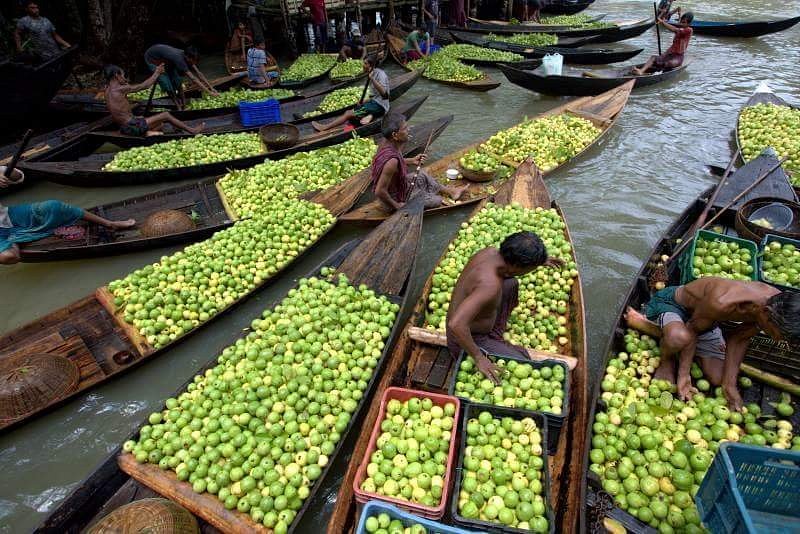
Floating Guava Market in Bangladesh
The floating market in Bangladesh, particularly in the Barisal region, is a testament to the country’s deep connection with its rivers and rich cultural heritage. Often referred to as the “Venice of Bengal,” Barisal’s floating market stands as a remarkable representation of how the daily rhythms of life are intricately tied to the flow of water. While the world around it continues to modernize, the floating market has remained a steadfast tradition for over a 100 Years, preserving a way of life that is uniquely adapted to the riverine landscape of Bangladesh.
A Glimpse into History:
The floating market in Barisal is one of the oldest traditions in Bangladesh, with its origins going back more than a century. Although the exact timeline of its inception remains unclear, the market’s existence is a direct reflection of the close relationship between the people and the rivers that surround them. Local farmers, many of whom reside in the river’s rural hinterlands, have long relied on these waterways to transport goods and services. Over time, this reliance evolved into the formation of an informal marketplace that is now a cornerstone of the local economy.
As Bangladesh continues to urbanize and modernize, many aspects of its rural life are slowly fading away. However, the floating market in Barisal remains largely untouched by this change. Farmers and wholesalers continue to gather at the crack of dawn, bringing fresh produce—including the famous local guava, which gives the market its name—as well as other fruits and goods, to barter and sell in the time-honored tradition of river-based commerce.

The Market’s Daily Rhythm:
Every morning, the waters of the river are alive with activity as small boats laden with produce float towards the market. Farmers row their boats from nearby villages, carrying fresh fruits, vegetables, and other goods. These boats form a bustling scene, weaving between each other in an almost choreographed dance. The air is thick with the aroma of ripe fruits, and the vibrant colors of the produce create a stark contrast against the still waters of the river. It is a sight that speaks to both the simplicity and the complexity of life in this region.
The guava, often the star of the market, is just one of many fruits sold here. Bananas, papayas, and seasonal vegetables also find their way into the boats, adding variety to the offerings. However, it is the guava that has earned this market its name and reputation. Known for its sweetness and unique taste, the fruit holds an important place in both the local economy and culture.
What makes the floating market truly special is its social and economic significance. It is not merely a place for buying and selling; it is a vital meeting point where farmers, wholesalers, and villagers come together, exchanging not just goods, but stories, news, and a sense of community. The market embodies a way of life that has been passed down through generations, where barter is still as important as cash transactions.


The River’s Role in the Market:
The floating market exists not only because of the river but because the river is the lifeblood of the local economy. In a country where nearly every part of life has been shaped by the presence of water, the river plays an indispensable role in facilitating trade and communication. In rural regions like Barisal, where infrastructure is limited, boats are often the most reliable and efficient means of transport.
The river has provided the locals with an opportunity to create a market that is both accessible and functional. The movement of goods by boat allows for the efficient transport of goods from isolated villages to the heart of the community. This water-based commerce is also environmentally friendly, using renewable resources to move goods, a practice that has survived centuries due to its sustainability.
Modernization and Preservation:
While Bangladesh’s cities are rapidly modernizing, with infrastructure projects reshaping urban landscapes, the floating market remains a symbol of tradition and resilience. Its persistence in the face of development is surprising, given the country’s push towards economic modernization. Yet, the market continues to thrive, largely unaffected by the pressures of the 21st century. It speaks to the enduring nature of certain practices that are rooted in culture and necessity.
However, there are challenges. As urban areas expand, the rivers are slowly becoming polluted, and the natural environment that sustains these markets is under threat. There is also the issue of modernization creeping into the rural areas, bringing with it roads, vehicles, and a shift in trade dynamics. Yet, despite these pressures, the floating market in Barisal holds its ground as a living example of how human ingenuity can create sustainable, community-oriented practices that endure the test of time.
The floating market in Barisal is more than just a place for buying and selling goods. It is a vibrant cultural institution that reflects the enduring relationship between people and the rivers that sustain them. In a world where modernization often leads to the disappearance of traditional ways of life, the floating market stands as a beacon of resilience. It is a reminder of the deep cultural roots that bind people to their land and waters, and a testament to the fact that even in an age of rapid development, some traditions are too valuable to fade away.



 2 Nights - 3 Days